Common Mistakes in Pilates: Signs You’re Doing Pilates Wrong (And How to Fix It)
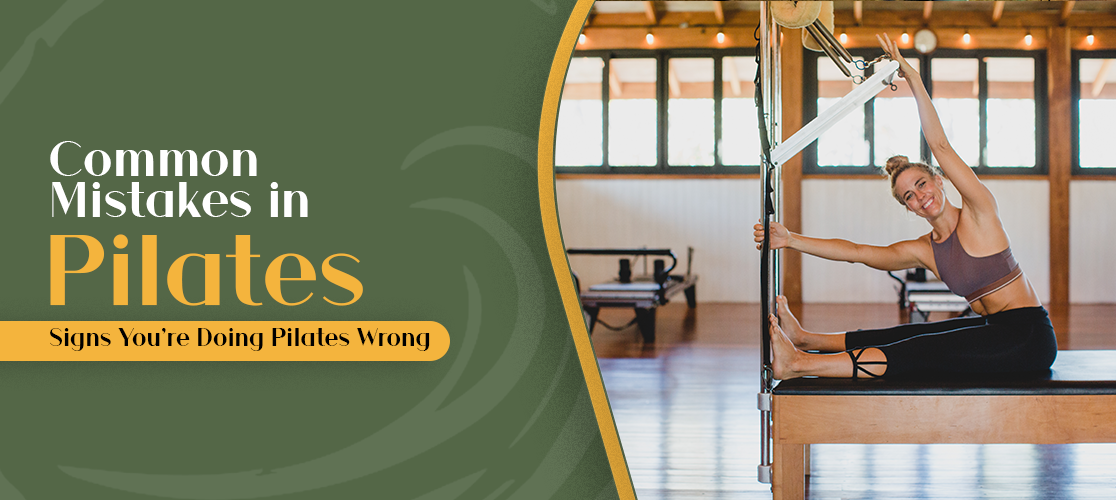
Common mistakes in Pilates are the hidden reason most beginners feel stuck, confused, or disconnected from their practice. Instead of building stability, their body begins to compensate. Instead of control, there’s strain in the body. And still no progress. Then the frustration starts inside you that usually sounds like “Why is Pilates hard?” or “Am I doing this right?”
The issue is rarely effort. Its execution. Even a small breakdowns in breathing, posture, alignment, and muscle activation quietly change the whole outcome of the workout. These common errors are subtle, but they can completely affect results over time. But once you recognize these patterns, everything shifts. Movement becomes intentional, the body starts responding correctly, and Pilates finally delivers control, strength, and balance.
Common Signs You’re Doing Pilates Wrong
The following signs are the most common indicators that something in your technique is off.
1. Neck Tension
If you finish your Pilates workout and immediately feel strain in your neck, shoulders, or upper traps. And the feeling that your body is not working the way it should. This is one of the big mistakes in Pilates because the load is supposed to stay in your core, not shift upward.
This usually happens when your abdominals are not fully engaged, so the upper body tries to “help” stabilize you. On the mat, it shows up in exercises like roll-ups or hundred variations where the chin pushes forward, and the shoulders lift. While on the reformer, it can appear during footwork when resistance is felt in the neck instead of the abs.
You’ll also notice that many of these issues feel different in mat Pilates compared to reformer Pilates. If you’re unsure which one suits you better. It’s worth understanding the difference between mat vs reformer Pilates for beginners before making a decision.
How to Fix?
If you’re feeling your neck or shoulders working more than your core. Let your shoulders drop away from your ears and stop holding tension there. Start moving, gently switch on your core so your body has support from the center instead of the neck taking over.
2. Rushed Movement
Pilates is designed around control, not speed. When you move too quickly, you remove the resistance your muscles need to actually work.
On the mat, rushing usually looks like using momentum to complete reps instead of controlling each phase of the movement. On the reformer, it shows up when the carriage is pushed out and snapped back without resistance awareness. This breaks muscle activation, reduces stability, and turns Pilates into a fast workout instead of a precision-based practice.
How to Fix?
There’s no need to rush through Pilates. Try slowing each movement down and notice what changes when you actually control the pace instead of just finishing the reps.
3. Poor Breathing Control
When breathing becomes irregular or shallow, your movement becomes tight and less connected. This is one of those mistakes in Pilates that quietly affects everything.
On the mat, you may hold your breath during core work like planks or teasers. On the reformer, breath often disappears during resistance exercises when effort increases. Without proper breathing in Pilates, the body tightens, movements feel heavier, and flow becomes disconnected from control.
How to Fix?
Most people don’t even notice when they stop breathing properly. Just keep it simple, breathe in before you move, and breathe out as you do the effort part. Don’t overthink it, just don’t hold your breath while working.
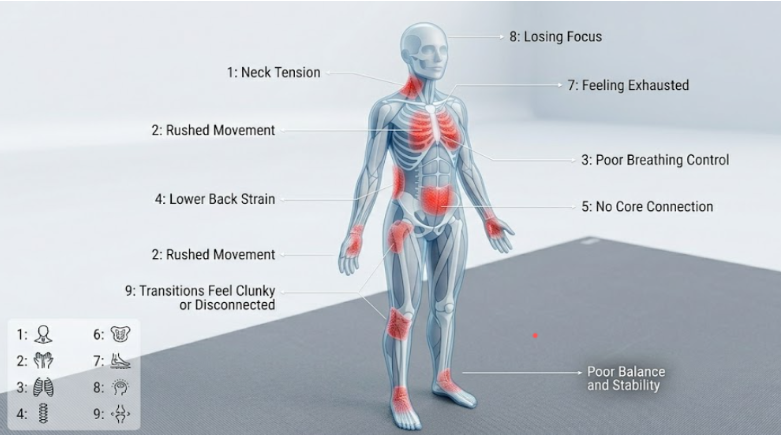
4. Lower Back Strain
If your lower back feels tight or sore after Pilates, your alignment is off. This is one of the most important Pilates mistakes beginners make because it directly affects safety and progress.
On mat exercises like leg lowers or hundreds, the pelvis often tilts, causing the spine to overwork. On the reformer, this appears during footwork or leg straps when stability is lost through the center.
How to Fix?
If your lower back starts to feel tight or uncomfortable during Pilates. That’s usually a sign you’re pushing too far or losing support in your center. You don’t need to force the movement. Just bring the range a little smaller and keep your core gently active the whole time. Let your stomach do more of the work so your back can relax and stay protected.
5. No Core Connection
One of the clearest signs that something is off is when you finish a Pilates session and don’t feel your core at all. You’ve done the work, but the abs feel completely “absent.” This is a very common mistake in the Pilates pattern, especially when the deeper stabilizing muscles are not activating properly.
On the mat, this shows up in roll-ups where the upper body leads instead of the center. On the reformer, it appears when strap work feels like it’s driven by the legs rather than the core. Over time, this reduces true core engagement and limits progress, even if you’re training regularly.
How to Fix?
Before each exercise, take a second to bring your attention back to your stomach. Think of gently drawing everything inward so your center is doing the work. If you feel it more in your legs or hips, reset and start again slowly.
6. Poor Balance and Stability
If you keep feeling a little unsteady during Pilates, like you’re constantly adjusting or trying not to fall out of position. That’s because your body hasn’t fully settled into proper control yet.
On the mat, this shows up when you’re doing single-leg work or slow, controlled holds, and your body keeps wobbling or shifting to stay upright. While on the reformer, it becomes noticeable when you’re standing or kneeling, and your balance keeps changing with even small movements. Most of the time, this happens because the deeper stabilizing muscles aren’t fully switched on yet, so your body is relying on bigger muscles to hold everything together.
How to Fix?
If you keep feeling a bit shaky or unsteady, don’t try to rush through it. That usually makes things worse. Slow down and give your body a second to settle before you move. It also helps to keep your eyes on one steady point. So, your balance feels more grounded and controlled.
7. Feeling Exhausted
It’s normal to feel tired after a Pilates session. But if you’re always walking away completely drained and not really noticing any kind of improvement over time. This means that your technique of movement is off.
Instead of the core leading the movement, your legs, neck, or hips start taking over. On the reformer, this can feel like your legs are on fire while your center feels almost untouched. On the mat, repeating exercises without real control just leaves you tired, not stronger. Over time, this can make Pilates feel harder than it actually should be.
How to Fix?
If you’re finishing Pilates drained but not really seeing any change in strength, something’s off in how you’re doing it. Try slowing down and easing the effort a bit. Remember, when you move with more control, your body starts getting stronger.
8. Losing Focus
At some point during Pilates, you might notice your mind drifting. You’re still moving, but you’re not really paying attention to what your body is doing anymore.
In longer mat pilates sessions sequences, it’s easy to slip into autopilot and just “get through” the workout. On the reformer, the rhythm of the machine can make you stop thinking about alignment or control. When that happens, the connection between your mind and body fades, and the movements become automatic instead of intentional. And that’s usually when form starts to slip without you realizing it.
How to Fix?
If you catch yourself zoning out during Pilates, don’t worry, it happens quite often. You’re still moving, but your attention is somewhere else. Just bring your focus back gently each time it happens. You can think about your breathing or how your body feels in the movement. Even a small bit of awareness can completely change how effective your workout feels.
9. Transitions Feel Clunky or Disconnected
If moving from one exercise to another feels a bit messy, rushed, or like you’re losing control in between. That’s actually something worth paying attention to. Pilates isn’t just about the exercises themselves, but how smoothly you move between them.
On the mat, this might show up when you switch from bridges to core work or from one position to another, and it feels slightly unsteady. Or in a reformer session, it can happen when changing positions or adjusting springs. Everything feels a bit rushed or unorganized. When transitions don’t feel smooth. This means your overall control and body awareness are still developing.
How to Fix?
Don’t rush from one movement to another. You should take a small pause so your body can reset before the next movement. That small moment makes everything feel more controlled and connected.
A lot of these movement issues don’t just happen with beginners. They come from how Pilates is taught in the early stages. We’ve broken this down in detail in our guide on common mistakes Pilates teachers make and how it affects student progress.
Ready to Fix Your Pilates Practice?
If even a few of these signs felt familiar, don’t brush them off. It just means your body is trying to tell you something about how you’re moving. These common mistakes in Pilates build up slowly, without you even noticing. Most of the time, the change doesn’t come from doing more, but from slowing down and correcting a few small things.
The longer these patterns continue, the harder they become to correct. A few small adjustments today can completely change how your body feels in your next session. Take the next step now. Explore guided Pilates sessions at Pilates Nosara and start building strength in a way that actually feels right for you.
FAQs
Q. Is Pilates hard or easy for beginners?
It can feel a bit hard at the start because everything is new and slow. You’re not just moving, you’re actually learning how to control your body differently. After a few pilates classes, it usually starts to feel much easier for beginners.
Q. Why does Pilates feel so hard at first?
Most people find it hard in the beginning because you can’t rush through it. Every movement needs control, and that takes a little time to get used to. Once your body understands it, things start to feel more natural.
Q. What should I expect in my first Pilates class?
Your first class will feel new and a bit unfamiliar. You’ll go through basic movements in which you learn how to breathe properly and focus on simple body positions.
Q. How do I prepare for a Pilates session?
Just wear something comfortable that lets you move easily. Try not to eat a heavy meal right before class and drink some water. The main thing is to come in relaxed and open to learning.
Q. What is a Pilates workout like?
A Pilates workout helps improve your posture, strength, and balance. It’s more about how you move than how intense it feels.
Q. Can Pilates cause injury if done wrong?
Yes, when you rush or don’t use proper form, you can strain your neck or lower back. That’s why moving slowly and staying in control is important.
Q. Is Pilates good for recovery?
Yes. Pilates is very safe for injury recovery. Many people use Pilates when recovering because it’s gentle and helps rebuild strength.
Related Resources
A Thousand Different Bodies In A Lifetime
A thousand different bodies in a lifetime. A teacher in training once said that she has learned so much through her thousand different…

Pilates Training Benefits for Climbing
Conquer Your Limits with Pilates: Jenni’s Journey to Climbing Mount

My Top 5 Things To Do In Nosara
Are you wondering how to plan the perfect trip to Nosara? Scroll down to see my list